


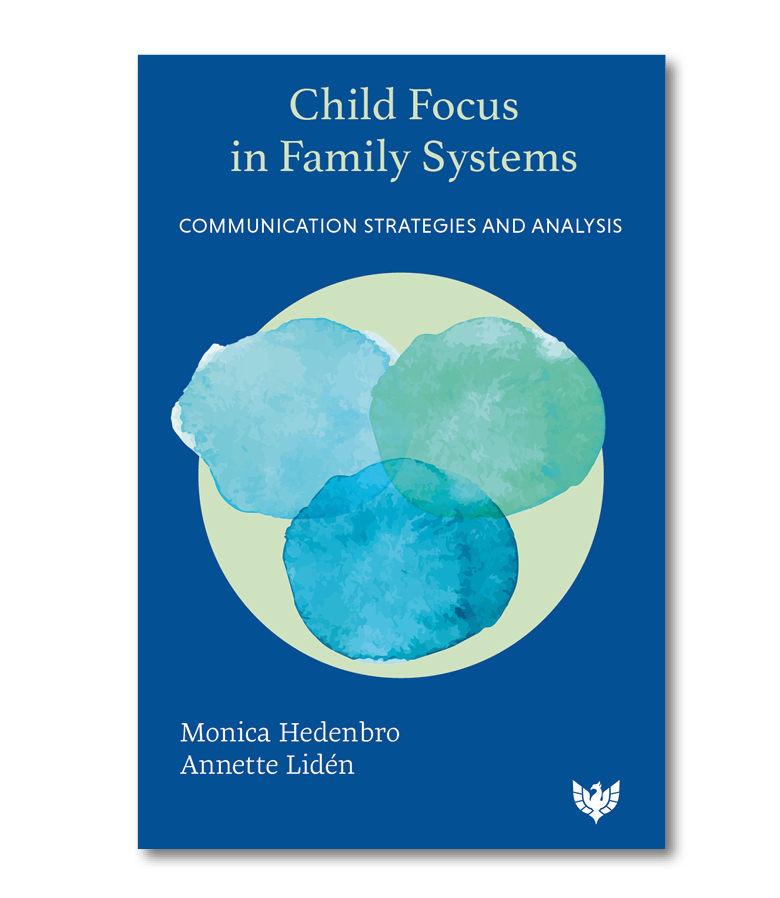
In traditional interaction research, the nuclear family has been the common starting point, and primarily the interaction in the mother-child dyad has been studied. Child Focus in Family Systems: Communication Strategies and Analysis highlights a paradigm shift where research and clinical practice have evolved into a broader and more complex, systemic family perspective. In this, the triad is central, meaning the interaction between the child and at least two adults in a coparenting relationship. The book shows how important coordination between the adults is for the child’s well-being. What does parenting look like in conflict or in moments of harmony and joy? How does this affect the child? And what influence does the child have on family dynamics?
In the early chapters of the book, the meanings of attachment, interaction, and synchrony in the interaction are described. The complexity of communication is highlighted, as well as how the child’s brain develops and how this affects the interaction. In the later chapters, the family system and the significance of the triadic interaction for the child’s development are described. Here, it is shown how the couple and parental relationship affect the child and vice versa. The importance of coordinated coparenting is emphasised, but also how the child, from a very early age, is an active participant, influencing the parents’ interaction and communication. A number of case vignettes beautifully illustrate the importance of the theory in child–parent interaction. This important and sensitively written book is a must-read for students and professionals in social services, child psychiatry, and healthcare involved in family support and parenting work.

 Annette Lidén is a social worker and licensed psychotherapist. She is an experienced clinician and teacher. She is a published author in Swedish.
Hugo Lagercrantz, MD, PhD, professor emeritus of pediatrics, Karolinska Institute and editor-in-chief, Acta Paediatrica –
‘The birth of the family and the dyadic interaction between the child and the parents are described in this excellent book. Furthermore, an overview of the literature on this topic from Spinoza and Buber to artificial intelligence is presented. This book is a joy to read for anyone with an interest in child development.’
James McHale, PhD, Professor of Psychology, Director, Family Study Center, University of South Florida –
‘Monica Hedenbro is a visionary and her book with Annette Lidén, is a scholarly, engaging, and fitting “denouement” to her decades-long journey taken alongside families. The lessons Hedenbro and Lidén have learned and the informed advice they provide will both be of great interest to families and professionals alike.’
Diane A. Philipp, MD, FRCP(C), Child and Adolescent Psychiatrist; Assistant Professor (Clinical), Department of Psychiatry, University of Toronto –
‘Monica Hedenbro and Annette Lidén present an extremely readable yet comprehensive review of the literature on infant development. The chapters are peppered with lovely vignettes from everyday life as well as Hedenbro’s longitudinal study of Swedish families. The section on triadic intervention is a gem. For clinicians looking to expand their practice to do whole family and coparenting work with the very young, this is a must-read!’
John Brendler, MSW, ACSW, LMFT, family therapist and founder of Building Bridges, a center for healing and change –
‘Child Focus in Family Systems is a significant enrichment to the field of family therapy. A distinctive feature lies in its attention to the increasing diversity of family forms in today’s world. Through extensive research, the authors create a map for understanding a child’s psychological landscape and nurturing their emotional intelligence, social competence, empathy, listening, and the curiosity to consider different perspectives. A particularly useful resource is the thoughtfully guided collaboration with parents observing videotaped recordings of interactions in their own families. In this way, parents can see their own contributions to family dynamics and discover concrete strategies that promote effective and emotionally engaged communication and connection with their children.’