

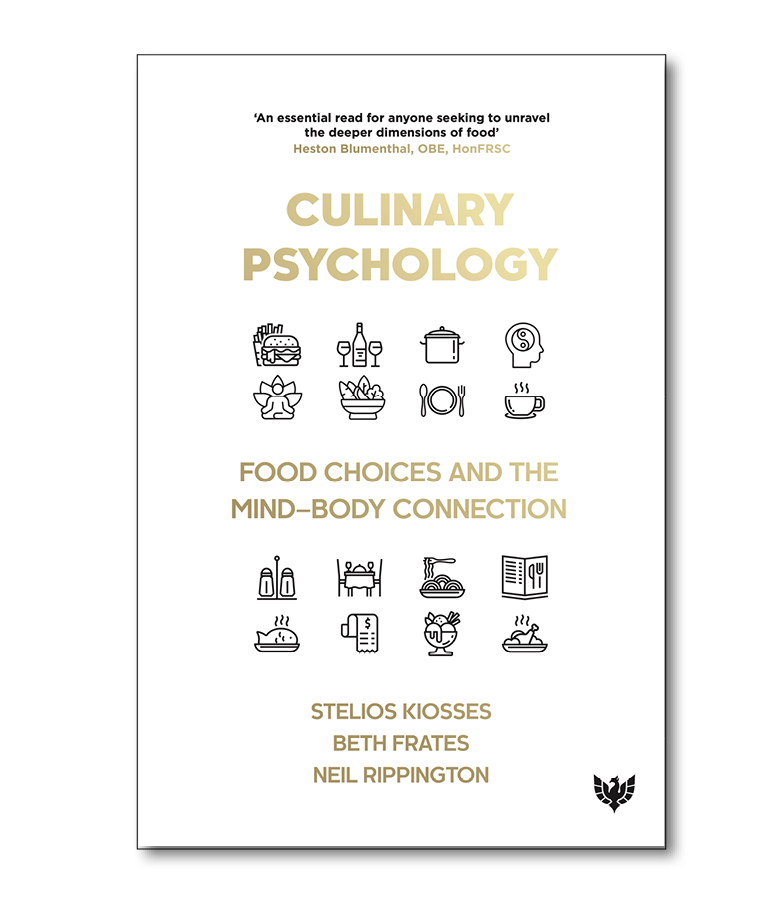
Stelios Kiosses, Beth Frates, and Neil Rippington are pioneering world leaders in the relatively new and important field of culinary psychology. Here, they present their must-read textbook on the subject, further enriched with chapters from Professor Charles Spence, world expert in multisensory perception and experience design, and Kimberley Wilson, chartered psychologist, author, lecturer, and podcast host.
Food is entwined in all of our lives. As a topic, it belongs simultaneously to many diverse fields, including economics, ecology, agriculture, and sociology. Culinary psychology incorporates many of these outlooks to understand and interpret the meaning of food and to investigate experiential as well as sensory perceptions. Healthy thinking and lifestyle patterns are an integral part of nutrition. Exercise, sleep, friendships, attitude, and alcohol all have a significant impact on the choice, the timing, and our enjoyment of the food we consume. What we eat impacts our mental health and even our libidos – with many comestibles feted for their aphrodisiac power. Added to all of this is the cultural and historical significance of food in our lives and the part it plays in celebrations and commemorations. Outside influences, such as societal expectations, market forces, and government legislation, also affect what and how we eat, as we can see from the rise of processed foods, snacking, and the use (or not) of cutlery and dining tables.
This superb resource brings together accessible expertise from these wide-ranging perspectives to demonstrate the importance of culinary psychology in our lives. As our understanding of the impact of what and how we eat continues to grow, this book’s comprehensive overview of culinary psychology will prove invaluable to students, academics, and the general reader.

 Beth Frates
 Neil Rippington
Heston Blumenthal, OBE HonFRSC –
‘Culinary Psychology is a fascinating exploration that resonates deeply with my own journey into the art and science of eating. As a pioneer of Multisensory Gastronomy, I’ve long championed the idea that true culinary pleasure extends far beyond mere taste, involving every sense – sight, smell, texture, and sound, amongst others – and indeed, our memories and emotions. This insightful book brilliantly unpacks the profound connection between our minds and what we eat, enriching our understanding of food choices. It’s an essential read for anyone seeking to unravel the deeper dimensions of food. I invite you to delve into its pages and discover how embracing mindful eating can transform your relationship with food, enriching both body and soul.’
Professor David Foskett, OBE MBE CMA FIH Bed (Hons) FRACA HMCGC Chevalier de l’Ordre du Merite agricole –
‘This groundbreaking contribution to the emerging field of culinary psychology offers hospitality professionals a deeper understanding of how culture, socialization, and motivations shape the ways people experience food and hospitality. It invites us to look beyond technique and service, and to consider the complex psychological and cultural factors that underpin truly memorable hospitality experiences.’
Chef Jozef Youssef, Founder of ‘Kitchen Theory’ –
‘Since this book landed on my desk, I haven’t put it down. As a chef and multisensory experience designer at Kitchen Theory, I have spent over a decade exploring the sensory and psychological relationship humans have with food and how this can be used to design better food experiences. This book does exactly that. From neurogastronomy and gastrophysics to mindset, sleep, social connection and sustainability, this book sheds light on how to turn these insights into meaningful experiences at home, in restaurants, classrooms, and clinics. Stelios Kiosses, Beth Frates, and Neil Rippington bring chefs, clinicians, and researchers into the same room and keep the conversation highly practical. What resonated most is the human angle: food as memory, emotion, story – not just fuel. If, like myself, your interest in food extends beyond just eating and cooking, put this book on your shortlist.’
Dr. Robert Brooks, former Faculty, Harvard Medical School and Director of Psychology, Mclean Hospital, Co-author of ‘The Power of Resilience’ –
‘It was truly a treat to read Culinary Psychology. While I was familiar with some of the topics in the book, other themes were new to me. All of the themes resonated with the strengths-based, resilience approach I have long advocated. The authors are gifted at presenting significant, meaningful information in such a warm, thoughtful, reader-friendly way. As I turned each page, I felt as if the authors were inviting me into the world of culinary psychology, teaching me its many features and how essential they are for our emotional and physical well-being. A constant thought I had while reading this book was my hope that as many people as possible would read it. Culinary Psychology represents a treasure of knowledge. It is a resource that will be read and re-read as we seek to enrich our lives in a very challenging world.’
Christopher de Bellaigue, Journalist and Historian, Founder of the Lake District Book Festival –
‘In this fascinating, many-flavored book, Stelios Kiosses and his fellow authors use food as a lens through which to explore our beliefs, our health and happiness, and even our inner lives – showing that we are not only what we eat, but also how we eat.’
Dr. Anastasia Hronis, Clinical Psychologist, Author of ‘The Dopamine Brain’ –
‘Bridging the kitchen and the clinic, Culinary Psychology makes the science of eating come alive. This book is a feast for anyone curious about the powerful links between food, the mind, and our health.’
Ragnar Fridriksson, Managing Director of Worldchefs, Host of World on a Plate podcast –
‘This book is a vital contribution to understanding the connection between food, behavior, and well-being. Stelios Kiosses, Beth Frates, and Neil Rippington offer powerful insights into how psychology shapes the culinary experience. A must-read for chefs, educators, and anyone passionate about the deeper meaning of food and its impact on our lives.’
Natasha de Bourg, Culinary Strategist, Director, and Executive Producer, Classy Chef Productions Ltd. –
‘This is one of the most eloquent and intellectually engaging works written on the deeper dimensions of culinary culture. When visionary minds converge, the result is a text that transcends traditional food writing and enters the realm of cultural philosophy. The book invites the reader to reconsider cuisine not simply as an art form, but as an intersection of geography, history, and human psychology. Through this lens, gastronomy becomes more than technique or creativity, it becomes a sustainable cultural expression shaped by place, people, and time. In an era where food systems, identity, and sustainability are central global conversations, this work stands as a revolutionary and timely contribution.’