


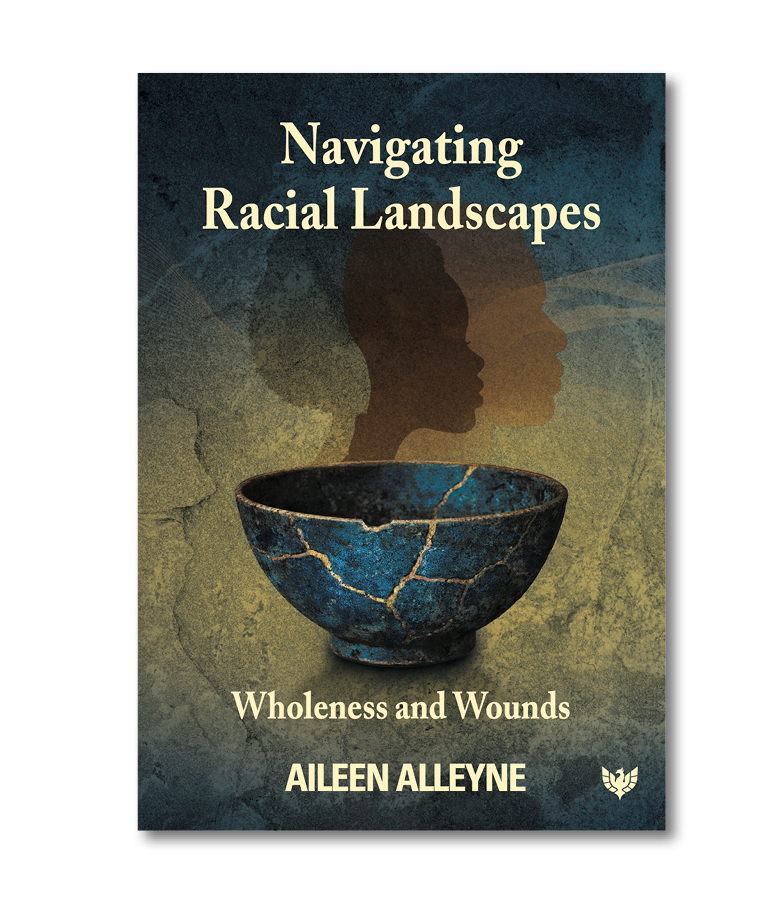
Navigating Racial Landscapes: Wholeness and Wounds is both a personal reflection and a professional manifesto, authored by a Black psychotherapist who has spent decades facilitating, teaching, and consulting within predominantly white spaces. Part memoir, part critical analysis, this book explores the psychological, relational, and political aspects of race in psychotherapy, questioning what it truly takes to navigate this experience with integrity.
Drawing on over thirty years as a psychodynamic psychotherapist, clinical supervisor, educator, and organisational consultant, Aileen offers a rare insider–outsider perspective. Her reflections seamlessly shift between the consulting room, the training environment, and the broader sociopolitical landscape, exposing the unspoken racial dynamics that influence every interaction. From the emotional toll of publishing her work on Black ancestral trauma to the exhaustion of teaching white individuals about race and the weaponisation of the term ‘woke’, these essays combine rigorous analysis with lived experience to highlight often overlooked issues.
The chapters alternate between historical analysis, theoretical context, case vignettes, and personal accounts. They are not presented as a manual but as provocations, invitations, and challenges. Readers are encouraged to reflect on their own racial positioning; to understand the body’s automatic responses to racial difference through a neurobiopsychosocial (polyvagal) perspective; to listen “in colour” by attuning to silences as much as speech; and to recognise how race appears in love relationships as well as in professional ones.
Reflexive, uncompromising, and sometimes unsettling, Navigating Racial Landscapes dismisses quick fixes and ready-made scripts. Instead, it promotes a continuous, embodied approach to race that values complexity without becoming defensive or despairing. Race is not an abstract subject to be mastered, but a landscape we all must learn to navigate – with humility, courage, and care. It is a book for therapists, trainers, educators, and anyone committed to engaging with race as more than just an abstract concept but as a lived, felt, and relational reality.
Báyò Akómoláfé, Hubert H. Humphrey Distinguished Professor of American Studies, Macalester College, USA; Founder, The Emergence Network –
‘Aileen Alleyne writes from the wound. She doesn’t write about it or around it. Her insider–outsider stance is not a methodology but a way of being: the body that is simultaneously inside the therapeutic institution and beside it, reading the accommodation from within its own sedimentation. What she calls “listening in colour” is a refusal of the greyscale neutrality that modern care demands of its practitioners. And her unflinching examination of “you make me whole” – the phrase that sounds like love and operates like governance – is one of the sharpest interrogations of the thesis of completion I have encountered. This book asks what it costs to navigate landscapes that were never drawn for your body. It does so with the fierce tenderness of someone who has been paying that cost for decades and has decided, at last, to name the invoice.’
Susie Orbach, co-founder, Women’s Therapy Centre, London and WTCI, NYC –
‘Passion, politics, and justice frame this thoughtful book. Clear clinical examples enable the therapist to understand dimensions that need addressing in the consulting room and inside of their own – perhaps unrecognised – biases.’
Stephen W. Porges, PhD, Distinguished University Scientist, Indiana University; originator of polyvagal theory –
‘Dr Aileen Alleyne’s Navigating Racial Landscapes offers a compelling and embodied exploration of racial experience, drawing on polyvagal theory to illuminate how our nervous systems shape connection, safety, and engagement. Extending these principles through domains shaped by her personal, clinical, and cultural experiences, she brings insight and originality to complex questions, contributing to our understanding of how biobehavioral state influences social engagement in contexts shaped by race.’
Kirkland C. Vaughans, PhD, Senior Adjunct Professor, Derner School of Psychology, Adelphi University; co-editor, ‘The Psychology of Black Boys and Adolescence’ –
‘This brilliant book tells a deeply personal story that speaks to universal truths, written in a voice of liberation, with the heart of a poet and the mind of a highly skilled clinician. It is a must-read for all psychotherapists of Colour who want to understand the torment of racialised labour and its consequences if left unprocessed. It is also a necessary study for White psychotherapists, empowering them towards self-healing through deeper recognition of their “implicated subject” position.’
5 star customer review, Jubriel Hanid on 01/07/2026 via www.karnacbooks.com –
‘You’ve finished your training; you’re up to date with the latest CPD; you think you’ve done everything to ensure you’re at the top of your game, then this book comes along.
So many new concepts, some of which I identified with as victim, some as unwitting perpetrator, and some as both, but all delivered with the kindness of a benevolent teacher. I highly recommend it.’
5 star customer review, Tania Caliendo on 30/06/2026 via www.karnacbooks.com –
‘There is a candid generosity which ripples through this legacy work. With global relevance, exposing and tending to micro level dynamics of power, such as the sonic colour line, every one of the 5 chapters of this book is packed with originality and crafted to be applied today in our work, personal and inner life.’
5-star customer review, Julia de Greff on 01/08/2026 via www.karnacbooks.com –
‘Simple and complex. Personal and political. Analytical and creative. Dr Aileen Alleyne’s book is a great read. I read it mostly in one sitting and I will read it again. It uncovers the defences we can use as therapists and as humans in regular interactions that keep us from true connection. It invites us to ‘see’ to ‘be with’ all that arises for us in our personhood and our bodies, and all that is there in the historical, societal, political and cultural context. In that way it invites us to be whole. It helps us to push off and let go of the cloak of lies and untruths and to open up to a much vaster way of being. Putting our micro interactions both within ourselves and within the racial landscape under keen observation, we are invited to lean into the discomfort, instead of turning away from it. This is surely what makes us more human.’
5 star customer review, Dr Rima Lamba on 11/08/2026 via www.karnacbooks.com –
‘There are words strung together to create meaning. And then there is Dr Aileen Alleyne. Her words don’t just sit in one’s mind, they enter and take residence in one’s soul. I love chapter 3 which examines the word and concept: Woke, something that has been demonised in much of society. Her poem at the beginning of the chapter speaks to what so many of us are witnessing as a cultural battleground as Aileen aptly named in her chapter 3 title. You need to read this book. You will not be disappointed!’
5 star customer review, Sophie Boss on 08/09/2026 via www.karnacbooks.com –
‘This is a beautifully written book that stayed with me long after I finished it. The writing is accessible and engaging, while the ideas are conveyed with warmth, insight and real humanity. As a psychotherapist and teacher, I particularly value the way the book communicates its message with such clarity and meaning. We use it as one of the course books for our psychotherapy trainees, and I think it offers them something important both professionally and personally. It encourages reflection without ever feeling heavy or overly complicated.’
5 star customer review, Lorraine on 10/09/2026 via www.karnacbooks.com –
‘This book resonates deeply. The line on soul repair struck a chord, drawing on polyvagal theory and co-regulation to describe something many therapists will recognise – the quiet cost of holding what clients bring into the room. Warm yet unflinchingly honest. I think it will land hard for a lot of clinicians reading it.’
5 star customer review, Umaa on 14/09/2026 via www.karnacbooks.com –
‘In these incredibly divisive times, we need holding, and this book holds and appropriately challenges. There are novel concepts that have translated into my private practice, and I’m really grateful for how accessible and generous an offering it is, there are clinical sharings, body awareness, and incredible poetry! Get your copy!’