


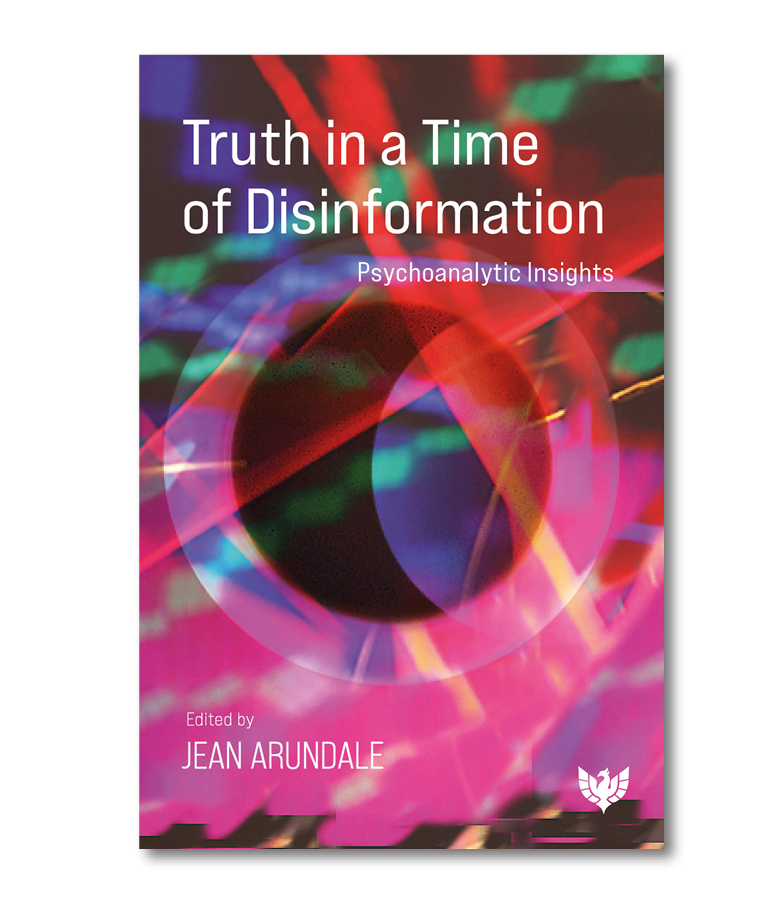
In an age where certainty has dissolved into opinion, and falsehood often travels faster than fact, Truth in a Time of Disinformation asks one of the most urgent questions of our era: what has become of truth, and how might psychoanalysis help us to find our way back to it?
From Plato’s forms to postmodern relativism, the book traces the long, complex evolution of humankind’s relationship with truth – its beauty, its necessity, and its fragility. Today, this ancient pursuit faces unprecedented threat as narcissism, power, and digital distortion corrode our shared sense of reality. The psychoanalytic lens offers a unique response: an exploration of how inner truth – our unconscious phantasies, denials, and projections – shapes both the personal and the political fabric of the world we inhabit.
At once a meditation on civilisation’s current crisis and a testament to psychoanalysis as a discipline grounded in truth-seeking, this book argues that the nourishment of truth – both emotional and intellectual – is essential for freedom, democracy, and psychic integrity.
Gathering leading psychoanalytic thinkers from across traditions and countries, the volume illuminates truth as a lived, relational process rather than an abstract ideal. The book features Jorge L. Ahumada, Jean Arundale, David Bell, Christopher Bollas, Ronald Britton, Giuseppe Civitarese, Sara Collins, Gregorio Kohon, Alessandra Lemma, David Morgan, Thomas H. Ogden, Elias M. da Rocha Barros, Eran J. Rolnik, Hanna Segal, Mark Solms, and John Steiner. They examine how truth emerges, is tested, and co-created in the analytic encounter. Their essays span philosophical reflection and clinical experience, linking the analyst’s consulting room with the public sphere and revealing the moral and emotional courage required to face reality without illusion.
Beautifully written and deeply relevant, Truth in a Time of Disinformation invites readers to reconsider what it means to know, to think, and to remain human in an age of distortion.
 Jean Arundale, PhD, is a training and supervising analyst for the British Psychoanalytic Association. In the BPA, she recently served as president, was chair of the Scientific Committee for six years, and worked on many other committees since the BPA was founded in 2010. Primarily in private practice in North-West London, Jean was a consultant psychotherapist working part-time in the National Health Service for more than forty years, supervising groups of psychotherapy trainees at Guy’s Hospital, London. She has taught widely and presented papers at University College London, the European Psychoanalytical Federation, and International Psychoanalytical Association conferences, and published papers and books on psychoanalysis, the most recent being The Omnipotent State of Mind, published by Routledge in 2022. Jean is presently serving on The International Journal of Psychoanalysis editorial board.
Francis Grier, Editor of the International Journal of Psychoanalysis, Training Analyst at British Psychoanalytical Society, teaches at Fitzjohn’s Unit, Tavistock Clinic. –
‘This is a remarkable book. It takes truth – psychoanalytic truth – as its guiding ideal, and explores both the grandeur of that ideal and the many ways it becomes embodied in clinical life. The volume is itself an enactment of that pursuit. Jean Arundale’s editorial vision, together with contributions from some of the most thoughtful writers in contemporary psychoanalysis, brings a rare clarity to questions that matter: What is truth? How do we recognise it? Is it beautiful, or dangerous?
These reflections unfold against the backdrop of a world in which the very idea of truth is increasingly eroded – sometimes even within psychoanalysis – by the seductive claim that everyone’s individual truth is equally sovereign, a formulation that too easily masks narcissism. This book stands firmly against that drift. It is a courageous and deeply intelligent defence of truth as a shared, demanding, and transformative ideal.’
Prof. Riccardo Steiner, Honorary Fellows, British Psychoanalytic Society and British Psychoanalytic Association, has written and lectured internationally, given the Sigourney Award in 2001. –
‘The work to discover psychic truth is the essence of psychoanalysis, yet the truth is a very complex one, linked with the notion of reality, and ultimately the final truths will always remain unconscious, as stated by Freud. Only by working together, comparing our different clinical and theoretical observations and discoveries, can we come nearer the truth. Each step we take is a gain for all of us. We learn from different schools and even differences in geographic parts of the world. This book is part of the continuing effort and should interest scholars not only in psychoanalysis but in educational, social, and even the political sciences.’
Prof. R. D. Hinshelwood, Fellow, British Psychoanalytical Society; Professor Emeritus, Department of Psychosocial and Psychoanalytic Studies, Essex University –
‘This is an excellent and broad survey of a field not often deeply mined, but of increasing relevance in our geopolitical world with its mindless advance to self-destruction. Psychoanalysis has its finger on the pulse of this interfering surge of irrational and deceitful polemics. The breadth of Arundale’s collection of authors is very comprehensive and though they may not agree on what is truly psychoanalytic, it is that fulsome acceptance of debate and alternative truths that makes this book such a generous offering for thought about our contemporary world.’
Sara Flanders, PhD, training analyst, British Psychoanalytical Society, works at Brent Adolescent Centre, is co-chair of the Forum on Adolescence of the EPF, and on the IJP Editorial Board –
‘What does psychoanalysis have to tell us about our notions of truth and reality, today so challenged in the age of fake news and recurrent, transparent presidential lies? Intrepidly, Jean Arundale has contextualised the question and gathered together distinguished essays by prominent psychoanalysts to address vexed questions contemplated in the West for more than 2,000 years and now, urgently, commanding attention in our daily lives.’