


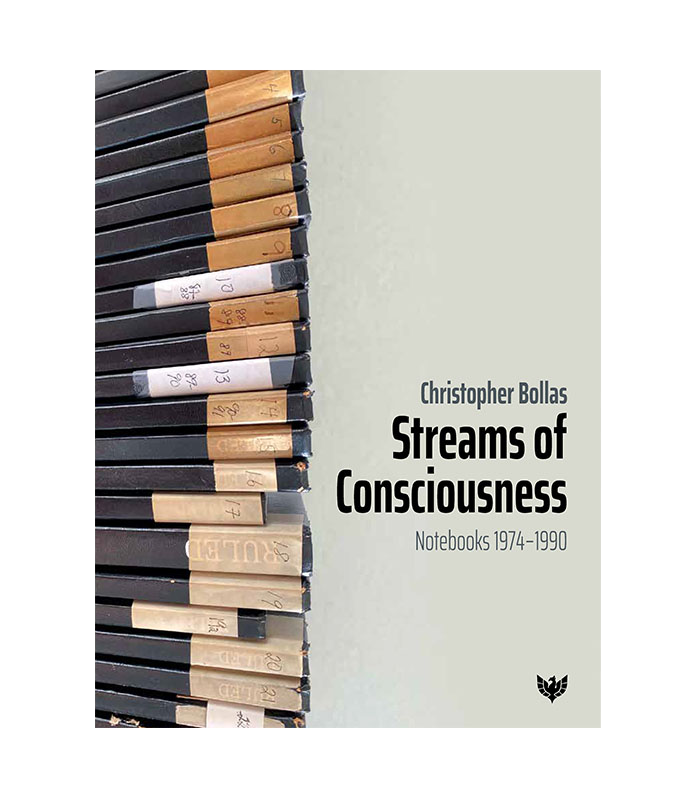
In Christopher Bollas’ Streams of Consciousness, a wide spectrum of theory and practice are explored, sometimes appearing in simple fragments, sometimes via complex lines of thinking that are developed in detail over time. As Bollas revisits the received truths and dogmas of his profession – including his own prejudices – he demonstrates the value of open, intelligent uncertainty. Interspersed with clinical preoccupations, which highlight the richness as well as the bewildering complexity of psychoanalysis, we find other ideas that reflect his early life as political activist, literature professor, and cultural critic. Throughout, the notebooks are enriched by references to the work of numerous writers in many fields who have influenced his thinking.
This work is essential reading for all with an interest in psychoanalysis which will enrich both academic study and clinical practice.
 Christopher Bollas is a psychoanalyst and Fellow of the British Psychoanalytical Society and the Los Angeles Institute and Society for Psychoanalytic Studies.
Steven Groarke, professor emeritus at Roehampton University and a member of the British Psychoanalytical Society –
‘Psychoanalysis doesn’t need masters – and yet, by any reckoning, Christopher Bollas is among the most brilliant psychoanalysts of his generation. He is also one of the most inventive, and the publication of his Notebooks is a significant event. Many of the ideas in these volumes will be familiar to Bollas’s wide international readership, many more will not. It takes time and requires close reading to discover the recuring patterns of meaning in this extensive collection of what were originally intended as private notes. The pleasure of discovery is sustained by the often-involuntary layering of associations, resemblances, and allusions. Gradually, as the process of thinking is repeatedly caught in the act of writing, the architecture of Bollas’s thought begins to take shape, affording the reader a valuable insight into the inner workings of an eminent psychoanalytic practitioner.’
Naomi Wynter-Vincent, The Year’s Work in Critical and Cultural Theory, Oxford Academic, 08 October 2025 –
‘Taken together, the two volumes of Streams of Consciousness are an intensely rich record of psychoanalytic creativity and theorization across half a century, and a gift both to Bollas scholars and the broader psychoanalytic community’
Josh Cohen, International Journal of Psychoanalysis, 2026, (107)(3):525-52 –
‘It does so, he ventures, by increasing the “self as object to itself, by enlarging its capacity for “rapport with internal objects”. The statement once again illustrates Bollas’ maximally expansive vision of clinical psychoanalysis as more than a treatment of illness. In line with the earliest traditions of philosophy, he frames it as an inquiry into the kinds of life we might wish for ourselves. We see repeatedly how simple insights and observations contain the kernel of an intricate theoretical edifice. “Freud”, he writes in 1977, “is after the meaning of the thoughts, not after the aesthetics of the dream” (I, 43). This is not a criticism of Freud, but a recognition that part of the logic of any project of thinking, even the most wildly ambitious, is a certain circumscription of its scope. This is by no means a reason to reject Freud, only to ask what he’s left out in defining his own domain of inquiry. Indeed, this commitment to the continual widening of the scope of psychoanalysis is one of the most unabashedly Freudian features of Bollas’ thought. The Interpretation of Dreams teaches us how to identify the symbolic compromises through which inadmissible repressed impulses find expression in the dream. Bollas is proposing a supplementary rather than alternate dream theory which would track how dreams reveal the dreamer’s aesthetic, the language and style in which they imagine the world.’