Contents
List of figures and tables
Preface and acknowledgements
About the editor and contributors
Part 1: Introduction: context and stance for the child psychotherapist
Orientation to play and psychoanalytic child and family assessment and therapy
– Carl Bagnini, Anabella Brostella, David Scharff, and Jill Savege Scharff
The ethical stance in child psychotherapy
– Caroline Sehon
Finding cultural humility
– Janine Wanlass
The research basis for psychoanalytic child therapy
– Janine Wanlass
– Learning from process notes
Janine Wanlass
Part 2: Child and adolescent development
The beginning of life
– Jill Savege Scharff
Classical psychosexual and psychosocial theories of child development
– Jill Savege Scharff
Infancy: The oral phase, integration, and disintegration
– Anabella Brostella
Toddlerhood: The anal stage
– Anabella Brostella
Preschool age: The phallic–narcissistic stage
– Jill Savege Scharff
Kindergarten age: The oedipal stage
– Caroline Sehon
Elementary school age: latency
– Ana Maria Barroso and Janine Wanlass
Middle school age: puberty and preteen
– Lea Setton
High school age: adolescence
– Ana Maria Barroso
Part 3: Psychoanalytic theory of childhood
Infancy: the mother–infant relationship
– Anabella Brostella
Attachment
– Janine Wanlass
Containment: Bion
– David Scharff
Holding, handling, and the psychosomatic partnership: Winnicott
– Yolanda Varela
Transitional space, transitional objects: Winnicott
– Anabella Brostella
The role of relationships in endopsychic structure formation: Fairbairn
– David Scharff
Early anxieties and projective identification: Klein
– Ana Maria Barroso
The child in the family group: transgenerational inheritance and Bion’s three basic assumptions
– Carl Bagnini
Unconscious communication: dreams and play
– Caroline Sehon
The interpersonal unconscious and the transgenerational transmission of psychic trauma
– Caroline Sehon
Sibling relationships and identity formation
– Anabella Brostella
The impact of divorce on children and families
– Kate Scharff
Suicide
– Vali Maduro
Neuroscience and psychoanalysis
– Caroline Sehon
Part 4: Clinical examples of wellness and symptom presentations of childhood
Symptom presentations of childhood
– Jill Savege Scharff
Situational and developmental crises: a healthy response
– Yolanda Varela
Somatoform disorder: a disorder of anxiety
– Aidalida Altamirano and Jill Savege Scharff
Obsessive–compulsive disorder: a disorder of anxiety
– Ana Maria Barroso
Suicidality: a disorder of mood
– Jill Savege Scharff
Addiction: a disorder of behavior
– Elizabeth Palacios
Psychic trauma: a disorder of reaction
– Caroline Sehon
Tic disorder: a disorder of mental functioning
– Jill Savege Scharff
Attention deficit/hyperactivity: a neuropsychological disorder of mental functioning
– Jill Savege Scharff
Learning disorders: disorders of written expression and reading
– Ana Maria Barroso
Anorexia and bulimia: disorders of psychophysiology
– Janine Wanlass
Encopresis and enuresis: a disorder of development
– Jill Savege Scharff
Autism: a disorder of development
– David Scharff and Jill Savege Scharff
Gender fluidity: a disorder of gender
– David Scharff
Part 5: The child psychotherapist at work in the treatment room
Working with parents
– Jill Savege Scharff
Assessing family dynamics
– Carl Bagnini
Child assessment for beginning therapy
– David Scharff
Transference and countertransference (focused and contextual)
– David Scharff
Interpretation
– Ana Maria Barroso
Psychotherapy with toddlers
– Janine Wanlass
Psychotherapy with latency age children
– Janine Wanlass
Psychotherapy with a teenager
– Ana Maria Barroso
Psychotherapy with adolescents and their families
– Anabella Brostella
Child psychotherapy using technology after COVID
– Elizabeth Palacios
Psychometric testing and psychodynamic formulation in child/adolescent assessment
– Janine Wanlass
Part 6: The child psychotherapist at work in the community
Consulting with schools
– Carl Bagnini
Working with family service agencies and child protective services
– Lea Setton
Child abuse and alternate care
– Janine Wanlass
Adoption and left-behind children
– Janine Wanlass
Epilogue
References
Index



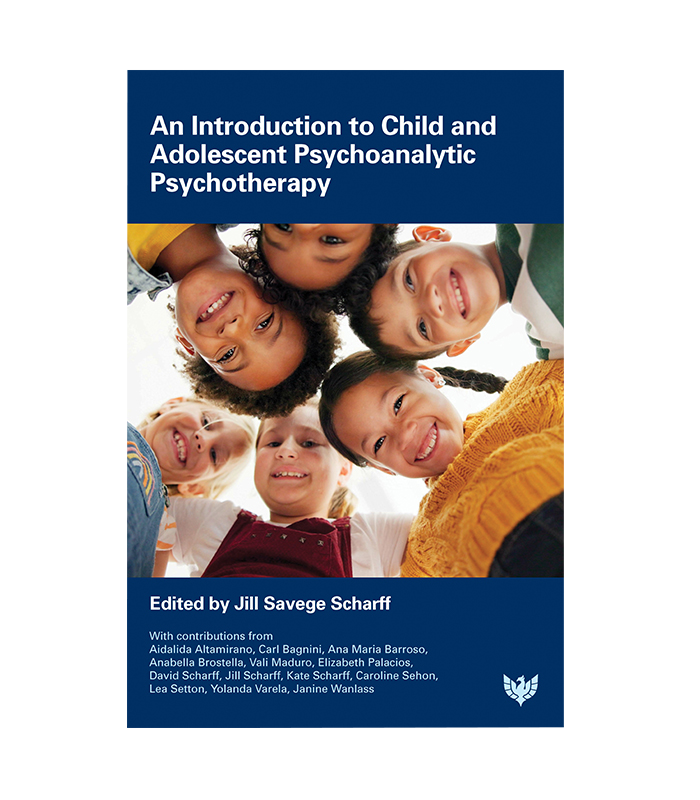
 Jill Savege Scharff, MD, is cofounder of the International Psychotherapy Institute (IPI) and founding chair of the International Institute for Psychoanalytic Training (IIPT) and of the Combined Child Analytic and Child Psychotherapy training program at the International Psychotherapy Institute in Chevy Chase, MD. She is the founding chair of IPI’s Child and Adolescent Psychotherapy training program at Jiandanxinli of Beijing, China. The author and editor of books on couple, child, and family therapy, and psychoanalytic therapy and education online, Jill’s latest edited volume is Psychoanalysis Online Volume 4. Her private practice in adult and child psychoanalysis, couple and family therapy is in Chevy Chase MD, USA. Jill is a recipient of the 2021 Sigourney Award.
Kerry Kelly Novick, Life-cycle Psychoanalyst; co-author, Working With Parents Makes Therapy Work, Freedom To Choose, and Good Goodbyes –
‘This extraordinary compendium offers both students and teachers of child psychotherapy a rich and eclectic survey of theory, practice, and technique with different age groups and populations. Read straight through as a textbook, or dipped into for insight about specific problems or situations, it delivers helpful and informed descriptions of all the different ways we can think about helping children and families move forward in their development. A great resource!’
Denia G. Barrett, MSW, Co-editor, The Psychoanalytic Study of the Child; Co-editor, Parentwork Casebook; past President, Association for Child Psychoanalysis –
‘This is no ordinary “Introduction” to the practice of child and adolescent psychoanalytic psychotherapy. It follows an exceedingly well-thought-out plan, while providing a carefully integrated collection of concise and detailed chapters – a compendium – on development, assessment, and psychodynamic ways of understanding symptoms, treatment, work with parents, and carefully selected psychoanalytic theoretical points of view. Jill Scharff and her colleagues also bring in multinational, cultural, and ethical considerations along with rich clinical illustrations and examples of work in the community. It’s a masterfully done text by master teachers and clinicians that is sure to become a welcome resource for learners and teachers alike.’
Jill M. Miller, PhD, Faculty and Training Analyst, Washington Baltimore Center for Psychoanalysis; Child and Adolescent Supervisor, various US Institutes; Co-editor-in-Chief, The Psychoanalytic Study of the Child –
‘Jill Scharff has given us a gift, one to those who are learning about child analysis, or yearning for a review, or just interested in the field. She and her international colleagues offer a framework to not only think about child analysis, but to teach it. Thus, it is a gift for us all. They provide a comprehensive overview of the basic principles of child analytic practice grounded in ethics, research, development, psychoanalytic theory, and technique. Included are the importance of considering cultural influences, the environment in which a child lives, in addition to the conscious and unconscious worlds of the therapist and the child. I highly recommend this book for the next generation of child psychotherapists and those who are dedicated to bringing them along – I loved reading it!’
Dr Jeanne Magagna, Tavistock-trained Child, Adult, and Family Psychotherapist –
‘Under the editorship of Jill Scharff, a group of excellent IPI psychoanalysts have created a timely, essential, and outstanding textbook of psychotherapy for use by all training bodies for professionals needing to understand children in a more in-depth manner. I was impressed by the comprehensive topics regarding children from infancy through late adolescence. This vast range of topics will enable professionals to comprehend, explore with children, and find ways of sensitively helping them relinquish impediments to their development and establish trustworthy relationships in which they can integrate aspects of their personality and build a competent and confident authentic self. The importance of creating a community of multidisciplinary concern through collaborative work between teachers, parents, and psychotherapists is also highlighted. Experienced clinicians will find that this book deepens their capacity to teach and be present for children, their parents, and trainees learning to work effectively with children and adolescents.’
Dr Angelina Archer MBACP, counselling psychologist, Therapy Today 36(9), November 2025. –
‘This book captures the complexity of psychodynamic theories beautifully. The cohesiveness of chapters from several contributing authors is a credit to the editor. The theories are supported by thought-provoking case studies and drawing that bring them to life […] The authors have successfully applied psychodynamic theory to modern clinical presentations and highlighted the potential challenges children face in various settings. As an integrative practitioner who uses psychodynamic theory, this book has been a valuable return to the basics. I wish it has been published when I was a trainee.’
Carl Bagnini, LCSW, BCD on 05/12/2024 –
‘This well edited introduction to child and adolescent psychoanalytic therapy has much to offer: The chapters are well organized by subject, and by the specific population served. While they are shorter than in other texts, the writing is clear and full of relevant clinical examples of the in vivo treatment situations with children, adolescents and families. There is also a focus on school settings, divorce, and neurodiverse populations. There is something of value in this compendium for early career therapists and seasoned therapists.
I recommend the reader start anywhere in the text that captures the clinical imagination, and work from there. You will not be disappointed.’