We humans contain multitudes. We do not have an internal world; we have many internal worlds. Time, circumstance, and the maturational processes will alter those worlds as we move through the life cycle. When we come for psychoanalysis, we will inevitably enact axioms from the many differing worlds inhabited by the self.
The assumed identifies three interrelated unconscious phenomena. First, the self’s erroneous assumption that consciousness comprehends the stream of unconscious contents passing through it in the here and now. Second, mental “constellations”, forms of memory that collect into a dense inner object, so that when the self thinks about one aspect of the constellation, the entirety feels as if it is there. Third, those forms of knowledge derived entirely from the “unthought known”: the knowledge that arrives out of actions and interactions.
This cluster of unconscious assumptions are crucial to human thinking and behavior. Therefore, identifying this realm offers useful perspectives on the self and on clinical practice to enable analytical work in these areas. When the assumed is weakened or breaks down, we are witness to psychotic processes, and the restoration of mental well-being is a crucial priority and must precede the search for meanings.
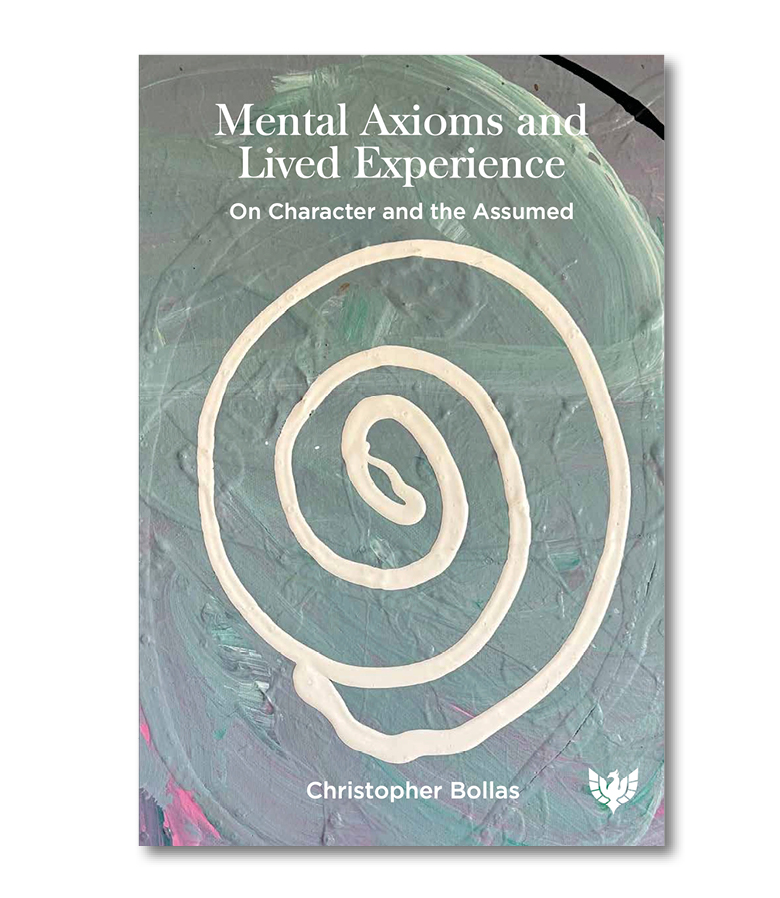
Mental Axioms and Lived Experience: On Character and the Assumed opens vital new perspectives to expand psychoanalytic thinking and understanding of the individual, society, and human nature. This makes it essential reading for practising clinicians, trainees, academics, and those of us interested in the complexities of the human mind.

Adam Phillips, psychoanalyst and writer –
‘More than a summation of the work of the most remarkable psychoanalytic writer of our time, the subtle clarity and incisive tact of this book about what Bollas calls “collaboration with one’s unconscious”, “our joy in being a self” shows us what it is and what it might be to be in quite new kinds of rapport with ourselves and others. Our assumptions will never be quite the same again.’
Anish Kapoor –
‘In the process of making art, there are many moments. There is the desire of what one wants to see, there may just be a sense of this, it may be discovered along the way. There is allowing accidents to happen, to be intensely focused, to discover what is forming, to stand back. Don’t think it, let it emerge – then think it, then watch. It is a receptivity to what is emerging within and without, a dialogue with the work and with oneself, a “self” that surely is formed in the processes Bollas describes in these pages. The receptive unconscious of infancy, the return of the repressed; it is feeling, it is the assumed, it is the unthought known, it is our own personal idiom, and all that we have experienced. All these states coagulate in the making of the work. Bollas offers us a careful analysis of the inner process to the unmade – unthought from which we emerge and per chance begin the journey back to the sea of maternal beginning.’