

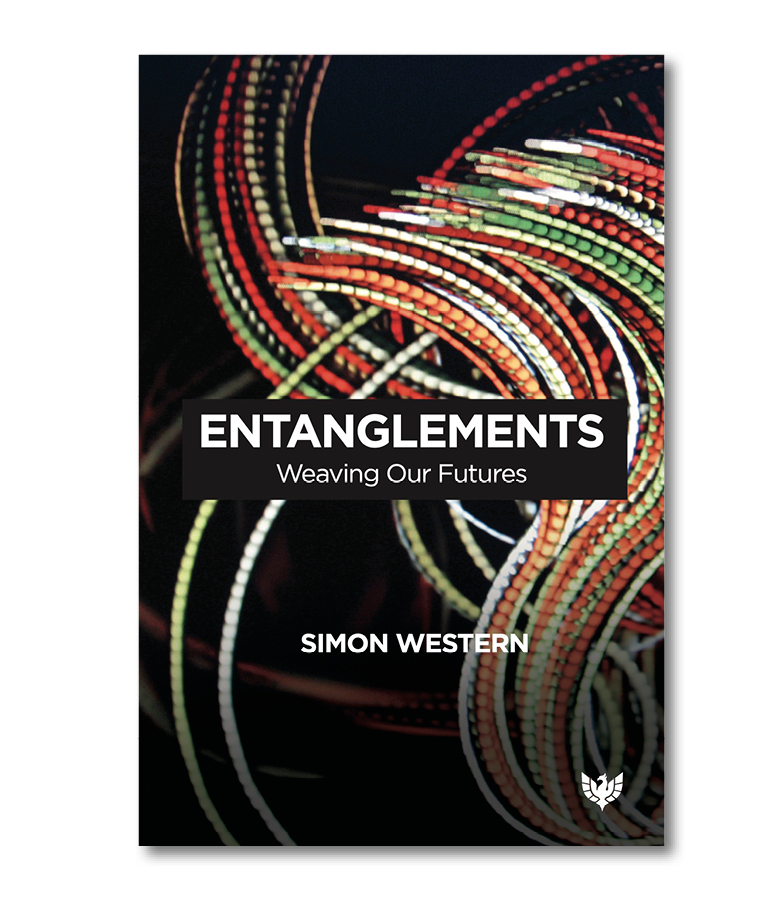
Entanglements: Weaving Our Futures brings a fresh re-imagining of the challenges facing us in our disruptive age that provides rich and nourishing food for thought. At the heart of the book is the recognition that we live in a new Precarious-Interdependent Age (P-I Age). This calls for a radical shift in how we relate to ourselves, each other, and to our environment. Simon Western presents a score and more of short essays that each respond to a dislocating social or political event: Covid-19, wars in Ukraine and the Middle East, the rise of ‘woke’ culture and populism, the climate crisis, the meaning of monarchy, and much, much more. Western invites us to ‘look awry’ at the world, enabling us to observe the unconscious currents and symbolic meanings that shape collective experience and personal identity.
These evocative reflections with a psychoanalytic sensibility are grounded in lived experience. Drawing on his unique journey from factory floor to nursing, family therapy, academia, and organisational leadership, plus a highly valued time as a stay-at-home father, Western bridges personal narrative with social critique. Themes of loss, care, power, desire, belonging, re-enchantment, and digital disruption are explored, always with the intention to provoke reflection and uncover possibilities for ethical and soulful ways of being.
Thus, Western does not deliver glib answers, pithy soundbites, or certainties. Rather, he opens a radical space to explore our troubled and entangled times. This book is unusual as it engages with the deeply personal, the political and the spiritual, utilising a critical but loving lens.

Manfred F. R. Kets de Vries, Distinguished Clinical Professor of Leadership Development and Organizational Change, The Raoul de Vitry d’Avaucourt Chaired Professor of Leadership Development, Emeritus –
‘“The way out is in,” wrote Vietnamese Zen Buddhist monk Thich Nhat Hanh. In this spirit, Simon Western explores the messy entanglements at the heart of human relationships and the inseparable ties linking our social and cultural lives with the more-than-human world. Drawing together events, cultural patterns, and personal experience, this book treats entanglement not as a problem to be solved but as a reality to be understood. By inviting readers to look beneath the surface – into the unconscious forces shaping perception and action – this book offers a powerful lens for making sense of our deeply interconnected world.’
Steven D’Souza, CEO and Founder of Liminal Edge Consulting, Former Senior Client Partner, Korn Ferry EMEA –
‘Entanglements by Simon Western is an insightful, deeply personal, and engaging book which skilfully weaves the psychoanalytic lens with critical leadership and organisational theory to bring an illuminating and fresh perspective to some of the most seminal events of our times. Written contemporaneously, it holds together like a rich tapestry, offering an important and relevant understanding not only of the past, but as an essential guide to a “Precarious-Interdependent” future.
Gianpiero Petriglieri, MD, Associate Professor of Organisational Behaviour, INSEAD –
‘In this collection of essays, Simon Western casts an unflinchingly compassionate gaze onto the troubled world we inhabit. A world, he argues, in which our lives are more precarious and interdependent than ever. Western invites us, provokes us, as the title suggests, not just to examine, understand, engage with others and the world – but to become entangled with it. His work evokes a hopeful possibility. That doing so deliberately, with our bodies and spirits, with our psyches and skills, might help us think more freely and relate more fully.’
Dr Susan Kahn, CPsychol, Fellow of the ABP, Chartered Psychologist, Supervisor and Coach –
‘Western is always encouraging us to look awry. To experience, to question, to really think about events and experiences with curiosity and depth. To consider what is happening systemically, what is going on below the surface, to us and between us. He is also always generous, willing to share his vulnerability and allowing us to accompany him on his journey. This book offers so much, the first part a collection of dislocating events – essays that have not been published together before and have a fresh perspective when weaved together; he is courageous tackling the Israel Palestine conflict, Trump, Brexit and Covid. The second part of the book looks at themes – such as the prevalence of positivity, therapy culture, the environment. Again agitating us to think differently, to pause to register the precarity. Finally he closes with two chapters that weave the notion of the Precarious Interdependent Age. It is a call to action that the author is part of and a call to search our souls and join him and society as we transform and try to live well.’