


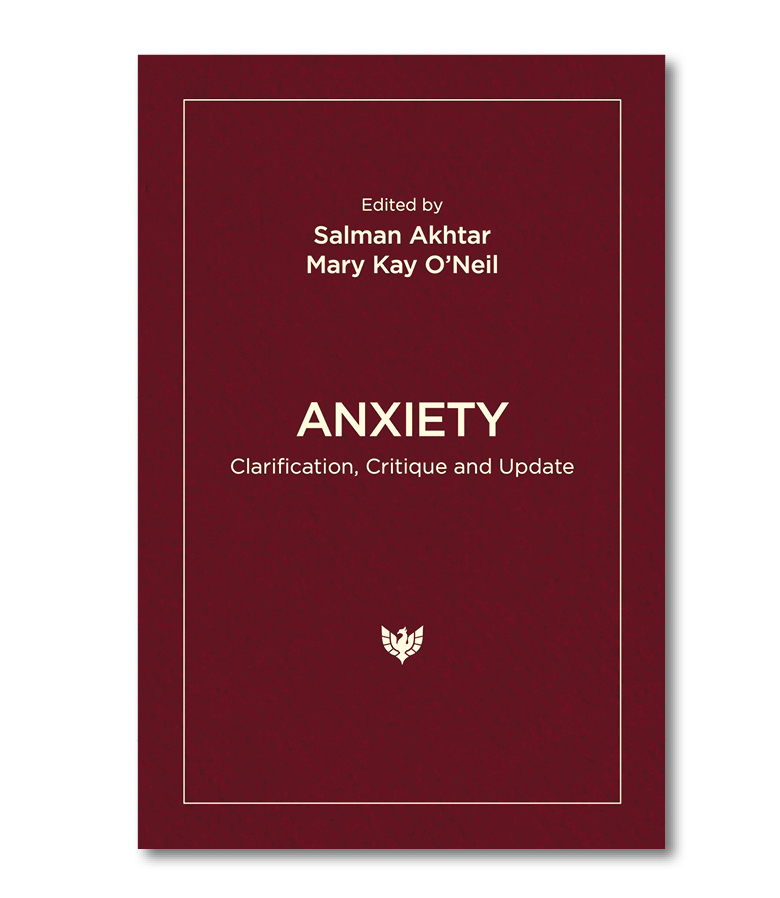
The book features contributions from a stellar international line up: Salman Akhtar, Maxine Anderson, Cobi Avshalom, Behdad Bozorgnia, Tom DeRose, Joseph Fernando, Alan Michael Karbelnig, Julie Jaffee Nagel, Gila Ofer, Mary Kay O’Neil, Nirav Soni, and Daniel Traub-Werner.
Anxiety is one of the most central concepts in both the theoretical and clinical foundations of psychoanalysis. Thus, the study of anxiety is, in effect, the study of psychoanalysis itself. Salman Akhtar and Mary Kay O’Neil have gathered together a thoughtful group of scholars to cover this challenging terrain. The book opens with two chapters that lay out the groundwork for things to come: the first offers succinct definitions of the plethora of psychiatric and psychoanalytic terms pertaining to this emotion; the second elucidates Freud’s changing views of anxiety. These chapters are followed by independent discourses on separation anxiety and castration anxiety that attempt to describe, critique, and update these well-established notions. A section on cultural matters follows which includes essays on performance and climate anxieties. Part IV focuses on the clinical process and provides three pithy discourses on the entanglement of anxiety with enactment, aging, and trauma. The fifth and final part explores the analyst’s clinical and professional anxieties.
The book’s approach arises from a multiplicity of perspectives. It aims to strengthen theory, clinical practice, and the technical skills of all psychoanalytically oriented therapists. It is essential reading for practicing clinicians, trainees, and students to help them gain a better understanding of the complexities of anxiety.
 Mary Kay O’Neil, PhD, is a supervising and training psychoanalyst and registered psychologist in private practice in Toronto, Ontario, Canada. Trained at the Toronto Institute of Psychoanalysis, she received her PhD from the University of Toronto and was an assistant professor in the Department of Psychiatry. Currently, she is president of the North American Psychoanalytic Confederation (NAPsaC), a member of the board of the Toronto Psychoanalytic Society, and on the faculty of the Toronto Institute. Formerly, she served as director of the Canadian Institute of Psychoanalysis (Quebec English), Montreal, and was a North American representative on the board of the International Psychoanalytical Association (IPA). In addition, she was a member of a number of IPA committees, including ethics and publications and also on the editorial board of the International Journal of Psychoanalysis. Author of The Unsung Psychoanalyst: The Quiet Influence of Ruth Easser, she co-edited seven other books and has contributed numerous journal articles as well as chapters and book reviews. Her research includes studies of depression, young adult development, sole-support mothers, the analyst as art collector, post-termination contact, and psychoanalytic ethics. Toronto and Montreal Foundations have funded her research activities.
FRED BUSCH, Ph.D., Training and Supervising Analyst, Boston Psychoanalytic Institute, Author, A Fresh Look at Psychoanalytic Technique –
‘Salman Akhtar and Mary Kay O’Neil have put together a unique volume on anxiety. They have enlisted distinguished contributors who approach this topic from varying perspectives. Thus matters of taxonomy, causation, accompanying fantasies, and defensive alterations of anxiety all feature in the pages of this book. It truly is a gift to the field, allowing us to find the latest on a most important topic.’
CHRISTINE DUNBAR, M.D., Training and Supervising Analyst (retired), Toronto Institute of Psychoanalysis, Coauthor, One Hundred Years of Psychoanalysis: A Timeline (1900–2000) –
‘This book is a gem. It offers an exhaustive and fascinating discourse on anxiety in its myriad forms. Above all, the essays contained in it help clarify all sorts of theoretical and clinical ambiguities. Akhtar and O’Neil’s book is an essential source of knowledge for a wide range of psychoanalysts and psychotherapists.’
DANIEL S. SCHECHTER, M.D., Psychoanalyst, Child & Adolescent, Psychiatrist, and Professor of Psychiatry, Lausanne University Hospital and Faculty of Biology and Medicine, Switzerland –
‘This well-edited and written volume takes the reader on an enthralling journey through the theoretical and clinical terrain of anxiety in its many forms and dimensions, from its fin de siècle Freudian conceptual origins to contemporary questions on the treatment of climate change and related socio-political anxieties. The book believe speaks wonderfully both to more and less seasoned psychoanalysts and psychotherapists – yet also to students across mental health disciplines and beyond (i.e., as an amateur musician, I adored reading a developmentally informed chapter and case-study focusing on performance anxiety).’