


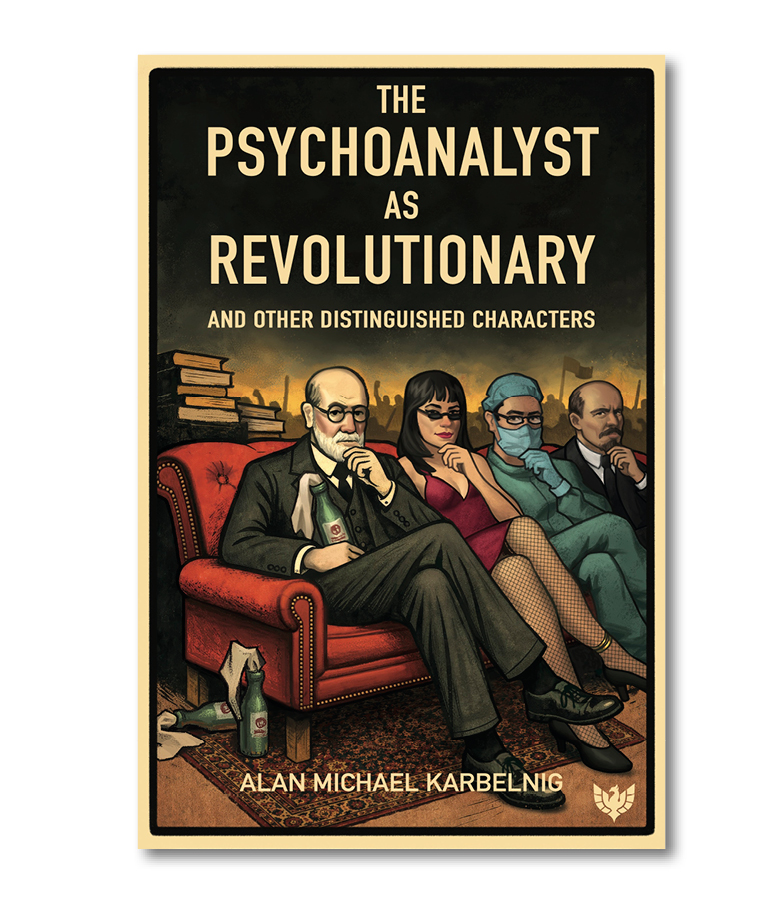
Psychoanalysts transform persons like revolutionaries alter societies: they liberate patients from the shackles imposed by their internal dramas. But revolutionaries are not the only fitting metaphor for the work of psychoanalysts. Prostitutes, dramatists, parents, doctors, surgeons, orthodontists, and exorcists all share commonalities with psychoanalysts. These occupational analogies are the perfect vehicles to introduce an understandable and easily explainable definition of psychoanalysis. It is a profession beset by infighting and an outdated public profile, and needs to embrace radical change to show its continuing relevance in today’s world. Human subjectivity emerges from a complex network of evolving sources. Thus, a pluralistic application of theoretical models is required, dependent on the patient, the analyst, and the evolution of the relationship.
Alan Michael Karbelnig calls for a revolution in psychoanalysis in his inimitable engaging, provocative, and brilliant style. Perfect reading for clinicians, The Psychoanalyst as Revolutionary is also gripping reading for all those interested in the mind, psychology, or psychoanalysis.

Enrico Gnaulati PhD, author of ‘Flourishing Love: A Secular Guide to Lasting Intimate Relationships’ and Affiliate Professor of Psychology, Seattle University. –
‘Alan Karbelnig’s book, The Psychoanalyst as Revolutionary, offers precisely what psychoanalysis needs to restore its unmatched value as a therapeutic method to address the root causes of suffering in many patients. He masterfully sketches, in accessible terms, the various schools of thought in psychoanalysis, wisely reminding us that, in the end, versatility and pragmatism—not rigidity and tribalism—are what matter. In truth, selecting from available psychoanalytic orientations that match the patient’s world will create the most transformative effects. A book that beginning and veteran psychotherapists alike, as well as therapy seekers, will definitely find informative, enlightening, and captivating.’
Salman Akhtar, MD Training & Supervising Analyst, Psychoanalytic Center of Philadelphia Author, ‘Comprehensive Dictionary of Psychoanalysis’ (2009) and ‘Psychoanalytic Listening’ (2013) –
‘Alan Karbelnig writes in the spirit of W. H. Auden’s quip that “there is no creativity without audacity” but also with utter loyalty to Donald Winnicott’s reminder that “there is no originality except on the basis of a tradition”. As a result, his effort at demystifying psychoanalysis and lifting the veil from myriad roles and activities of the psychoanalyst turns out to be simultaneously scholarly and engaging, historical and innovative, and straightforward and multilayered. This is contemporary psychoanalysis at its pragmatic best!’
Prof. Jon Mills, Department of Psychosocial & Psychoanalytic Studies, University of Essex, UK, and author of ‘Being There: Working with Trauma, Psychosis, and Extreme Mental States’ –
‘What does it mean to be a psychoanalyst? Alan Michael Karbelnig decodes the mystery and provides us with a conceptual template that cogently captures the essence of psychodynamic thought and clinical practice. He provides us with penetrating insights into the universal processes that motivate, shape, and hinder human potential and why psychoanalytic practitioners of all stripes are particularly well-suited to become transformational agents of change. In clear and accessible language, he guides us through a metaphorical landscape that symbolizes the complexifications of the psyche, the therapeutic relationship, and the human condition. For those who lament a lack of orienting principles in the training and cultivation of the psychoanalytic mind, this book does just that. Revolutions aim to bring about positive change, even through the resistance of hope. Every therapist in training should read this book from a master clinician.’
Dr. Phil Ringstrom –
‘Alan Karbelnig lays out a cogent argument for how the 130+ year tradition of psychoanalysis went haywire due to the continual tribalistic infighting between psychoanalytic schools. He proposes an organizational schema for tying together elements common to how all psychoanalysts work. Dr. Karbelnig’s organizational project is both simple and elegant. He emphasizes how each analyst must become a fellow revolutionary, helping their patients revolt against the confinements of their own minds while privileging the psychoanalytic pair’s mutually influential process. In this second book of his, Dr. Karbelnig again presents his encyclopedic grasp of psychoanalysis in everyday language.’