


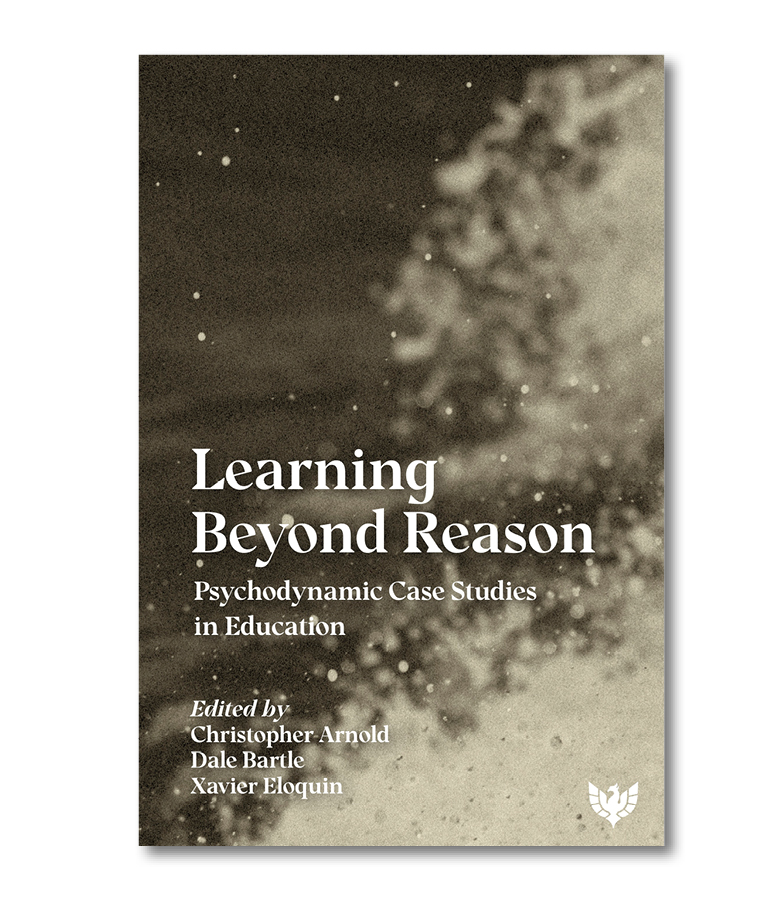
Learning Beyond Reason: Psychodynamic Case Studies in Education includes contributions from Zahra Ahmed, Christopher Arnold, Dale Bartle, Gemma Ellis, Katie Ellis, Xavier Eloquin, Hannah Fleming, and Aaron Reynolds. Three of the five case studies are based around individual students or young people and the remaining two involve groups of adults involved in working with young people. The first chapter offers an overview of the approaches when applied to individual case work. The second focuses on emotionally based school non-attendance (EBSNA) and the third on working with a young person with multiple social challenges. Chapter 4 takes a psychodynamically informed view of a difficult whole school situation, which includes an analysis of complex relationships in a specialist school. Chapter 5 describes a technique for use with groups of adults working with young people and the insights that arise out of the application of these methods.
Each chapter focuses on the unique contributions of psychodynamically informed theories and techniques. The aim: to highlight the efficacy and humanity of psychoanalytic approaches in difficult situations involving young people. It is also hoped that this volume permits space for the reader to reflect on any emotional responses to the situations described in the case studies
This companion book to the editors’ previous publication, Learning from the Unconscious: Psychoanalytic Approaches in Educational Psychology, highlights and publicises the practical applications of such approaches. It can be read as a standalone text or a follow-on that puts theory into practice. It is essential reading for educational psychologists, teachers, educational administrators, trainers of educational psychologists, parents of children with additional needs, and charity workers involved with the lives of children with additional needs.
 Dr Xavier Eloquin is an educational psychologist, coaching psychologist and Human Givens therapist. He is an associate fellow of the British Psychological Society. Dr Eloquin has written a number of articles and chapters exploring the interface between educational psychology and psychoanalytic ideas. He co-edited the previous volume entitled Learning from the Unconscious and contributed an account of his family’s experience of lockdown in the Covid-19 pandemic.
Prof. Dr. Christoph Steinebach, former President, European Federation of Psychological Associations –
‘In an era where educators and practitioners face increasingly complex developmental challenges, resources that illuminate the deeper, often irrational, aspects of learning are essential. This volume, Learning Beyond Reason, provides a vital pathway to that understanding. By presenting richly detailed psychodynamic case studies, the editors and authors succeed in cutting through surface-level behaviours to address the fundamental emotional and relational processes that shape a student’s inner world. For those committed to fostering genuine resilience and promoting positive mental health outcomes, this work is invaluable. It is a necessary and powerful contribution to applied psychology in educational settings, urging us to look beyond metrics and truly see the whole, complex individual.’
Dr Tracey Williams, principal educational psychologist, Brighton and Hove, UK –
‘An accessible and insightful exploration of working with complexity through a psychodynamic lens. Rich case studies bring theory to life across individual, group, and organisational contexts, with the chapter on “emotional school-based non-attendance” offering a particularly thoughtful reflection on collaborative work between local authorities, schools, and families to develop shared narratives and meaningful solutions. The inclusion of a clear and helpful glossary strengthens understanding of key concepts such as containment, transference, and projection, supporting deeper reflection on what may be happening beneath the surface. This is a valuable and timely read for educational psychologists and educational leaders seeking psychologically informed approaches to complex presentations.’
Dr Anthea Gulliford, PhD, MEd, PGCE, MSc, MA, associate professor in educational psychology, University of Birmingham –
‘Understanding the human processes that enable learning and development is crucial. This text offers perspectives that enable us to move beyond the familiar cognitive or information processing models of interaction in the education or therapeutic domain. Continuing an important tradition of psychodynamic thinking, it illuminates how psychodynamic knowledge may influence our understanding and practice. Through providing examples and insights, the accounts here open up possibilities for practice developments, through drawing on reflective insights for working in emotionally charged, challenging, or even more routine contexts.’
Mojca Juriševič, PhD, professor of educational psychology, University of Ljubljana –
‘Reading this extraordinarily well-written book was, for me, first and foremost, a deeply inspiring professional journey, taking me from the art of applying psychodynamic theories in practice to deeper personal reflection in my role as an educational psychologist, primarily working in teacher education. Across five chapters, the editors impressively and clearly synthesise key psychodynamic concepts, showing how psychologists can meaningfully integrate these ideas into educational practice. The text presents carefully selected interventions based on sound methodology while maintaining a clear focus on learners’ lived experiences. Importantly, the approaches described can be applied in a variety of educational settings, regardless of the learner’s age, making the book relevant for practitioners working with learners of all ages. In an era increasingly shaped by artificial intelligence and perpetual time constraints on ourselves and our relationships, the message of this book becomes even more significant. It compellingly demonstrates that investing in emotional development and reflective relationships based on evidence-based practice contributes not only to psychological well-being and mental health, but also to deeper, more sustainable forms of learning that extend far beyond mere academic achievement. Although the examples and contexts discussed are rooted in the British system, I believe that the theoretical insights and practical implications can be transferred to many other educational contexts. I warmly recommend this book to my colleagues in educational psychology as well as to students of psychology wishing to deepen their understanding of psychodynamic perspectives in contemporary educational practice.’
Dr Brian Davis, principal educational psychologist and director at Peaches Psychology Ltd; former Director for Child and Educational Psychology Professional Doctorate Training –
‘This book considers potential restrictions inherent in overreliance on positivist, linear approaches in our practice. Important for psychologists, it is also of interest to other professionals working across education, social care, and mental health. Informative content draws on knowledge, expertise, and experiences of educational psychologists applying psychoanalytical perspectives, sometimes alongside positivist thinking, at individual young person, group, or systems levels. The authors’ helpful definitions, analysis, and interpretations guide readers into considering how they might also incorporate psychoanalytical thinking within casework, self-identification of their support and well-being needs, and their supervision. The co-existence of the personal and the professional is acknowledged as authors think about the person in role and the thoughts and motivations of others in systems, both in the conscious and unconscious states. In dissecting contributory factors in diverse casework, important concepts are illuminated, including relational considerations, reverie, containment, and defence mechanisms. It is demonstrated that assessment, including the application of projective techniques, alongside thoughtful questioning and reflection, incorporates these concepts, informing understanding, formulation, and intervention. Particularly motivating is the guidance towards advanced freeing of our imagination and creativity through reflection on contributions from great thinkers in philosophy, poetry, and psychoanalysis, with a hint of Indie rock on the side.’